Intelsat 901 / MEV1 mission

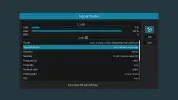
I get another one 3831 R .

The signal is weaker but the channels work well without cuts.
 

Attachments

  • screenshot_20200405021943.webp
    screenshot_20200405021943.webp
    36.4 KB · Views: 30
  • 1_0_1_2_C9_1_CFC8EF7_0_0_0_20200405022237.webp
    1_0_1_2_C9_1_CFC8EF7_0_0_0_20200405022237.webp
    46.1 KB · Views: 38
In my humble opinion, the signal has slightly decreased.
Channell Master 120 from northern Tuscany.
 
Just a thought.

11600 is one of those frequencies that can be masked by installation anomalies, either the LNB or the cabling. I recall it being a bugbear of installations years ago on analogue reception, where CNN from Astra 1 could be covered in sparklies unless something was replaced, be it as simple as an f-plug at either end of the run.

On a DiSEqC system there is the additional internal motor circuitry (plus two other connections) that might be causing a poorer signal at this frequency.
 
Will check with the analyser later today to see if I can recreate it here, but I recall 1750(MHz) as being the troublesome figure.
 
Last edited:
Isnt 11600 one of the frequencies that can be affected by dect phones?
 
We don't have one of those, I do have some preliminary results though with the kit here, just running a second cable to bypass the HtoH to see if that is behind some of notches/noise in the spectrum.
 
Besides the BBC package,whose signal we can check with standard receivers,because they use the usual parameters,the other active frequencies on this satellite are for data transmission.So you will need a device capable of detecting both the signal and the parameters used on these frequencies.And I ask then with what device do you check for anomalies in your reception system?
In case there are no signal problems at the BBC,then try a device that knows how to read the parameters(16/32APSK,mode ACM,etc) used for data transmission,such as most transponders used on this satellite.
That's what I'd do if I were you.It is true that I have a dvb card and applications that help me determine what problems I have at the reception,whether it's from your reception system(signal attenuation), or from interferences.

 
Ok. Preliminary checks suggest the frequency is affected by motor throughput and is increased by smaller reflectors (G/T). Pictures from the analyser in a moment
 
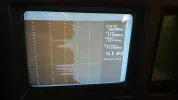
In each of the following tests all peripheral equipment has been switched off in the room, apart from the Satlook NIT analyser

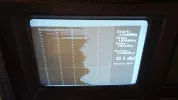
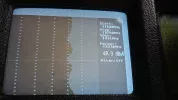
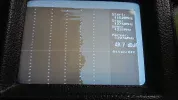
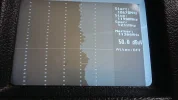
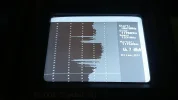
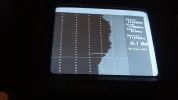
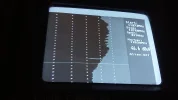
OK, first up , imagery of the bands from a fixed 1m dish, connection directly to the LNB. As you can see there is nothing on the opposite polarity or upper band near the frequency of interest (which is white six dots up from the base of the screen)
 

Attachments

  • 1.webp
    1.webp
    109.1 KB · Views: 20
  • 2.webp
    2.webp
    76.1 KB · Views: 19
  • 3.webp
    3.webp
    88 KB · Views: 17
  • 4.webp
    4.webp
    71.9 KB · Views: 20
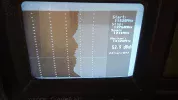
Next, same dish but this time the analyser takes the incoming signal through the HtoH actuator (in this case an Alsat device)

(The three other quadrants of the universal LNB only)

Spot the small notch of 'signal' near the required frequency
 

Attachments

  • 1.webp
    1.webp
    130.3 KB · Views: 18
  • 2.webp
    2.webp
    152.4 KB · Views: 17
  • 3.webp
    3.webp
    132 KB · Views: 16
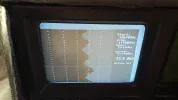
Lastly another installation on the roof, this time an 80cm reflector on a similar H to H motor. Again the analyser is receiving signal from the LNB through the motor connections. I will double check the analyser imagery for the fourth polarity tomorrow as it is now getting late but you should be able to see the noise from the circuitry within the gearbox is - almost certainly - generating a peak at a single frequency down the incoming cable to the room.
 

Attachments

  • 1.webp
    1.webp
    73.6 KB · Views: 13
  • 2.webp
    2.webp
    82.1 KB · Views: 12
  • 3.webp
    3.webp
    89.2 KB · Views: 11
Back
Top