Paksat 1R 38E

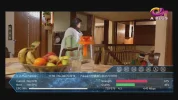
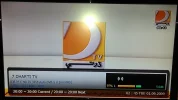
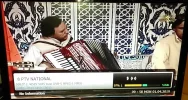
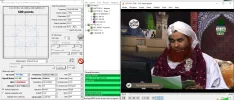
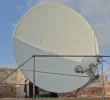
Thought I would have a bash at this one with a Chapparel Tri Band Corotor in the Midlands with a 1.8, managed to lock a transponder with good level, might get some more with a tweak..P1010018.webpP1010019.webpP1010020.webp

 
Thought I would have a bash at this one with a Chapparel Tri Band Corotor in the Midlands with a 1.8, managed to lock a transponder with good level, might get some more with a tweak..View attachment 125748View attachment 125749View attachment 125750


Nice DX'ing, a good signal catch.

What LNB's are you using on the Chaparral Tri-Rotor for Ku-Band and C-Band? The C-Band looks like a Norsat and the Ku-Band looks like a dual output Swedish Microwave?
 
Nice work. I could always get around 3 or 4 transponders on that satellite but haven't tried it any time recently.
 
Nice DX'ing, a good signal catch.

What LNB's are you using on the Chaparral Tri-Rotor for Ku-Band and C-Band? The C-Band looks like a Norsat and the Ku-Band looks like a dual output Swedish Microwave?
 
Nice DX'ing, a good signal catch.

What LNB's are you using on the Chaparral Tri-Rotor for Ku-Band and C-Band? The C-Band looks like a Norsat and the Ku-Band looks like a dual output Swedish Microwave?

Ku is a SMW dual output with a 22Khz switch in line and the C Band is a Patriot PLL.
 
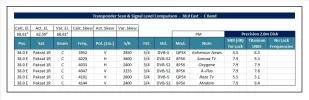
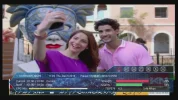
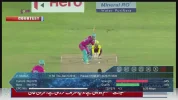
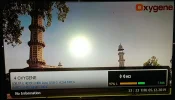
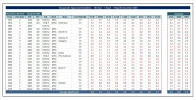
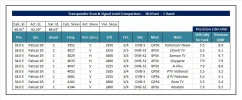
Attached below is today's scan result table and some channel pictures from my scan of 38.0 East in C-Band.

I managed to achive signal locks on 6 frequencies, all of which were stable enough to provide channel picture screen grabs without any pixelation. Most of the signals seem to be stronger in the evening apart from Roze TV (4101V) which seems stronger in the morning.

.
 

Attachments

  • 38.0E_20191205_Table.webp
    38.0E_20191205_Table.webp
    35 KB · Views: 10
  • 38.0E_20191205_3952V_p01.webp
    38.0E_20191205_3952V_p01.webp
    119.6 KB · Views: 9
  • 38.0E_20191205_4029H_p01.webp
    38.0E_20191205_4029H_p01.webp
    91.3 KB · Views: 9
  • 38.0E_20191205_4033H_p01.webp
    38.0E_20191205_4033H_p01.webp
    140.7 KB · Views: 8
  • 38.0E_20191205_4047V_p01.webp
    38.0E_20191205_4047V_p01.webp
    102.7 KB · Views: 8
  • 38.0E_20191205_4101V_p01.webp
    38.0E_20191205_4101V_p01.webp
    138.8 KB · Views: 9
  • 38.0E_20191205_4144V_p01.webp
    38.0E_20191205_4144V_p01.webp
    129.6 KB · Views: 9
Update:

I managed to lock another one making it a total of 7 frequencies. The signals seem to be marginally improving as the evening progresses? The new frequency locked is Dharti TV (4017V), picture attached below. I am just over the threshold for a lock on this one at 5.6dB with 5.5dB needed for a lock.

.
 

Attachments

  • 38.0E_20191205_4017V_p01.webp
    38.0E_20191205_4017V_p01.webp
    77.3 KB · Views: 8
Update 2:

Another one locked making it a total of 8 frequencies. The new frequency is PTV National (4052V), picture attached below.

.

Your doing well ..... i find it an odd satellite ... reception of a transponder might be good for a few nights then go weak or disappear completely a few days later ...
Certainly better reception for you in the south than it is for me up here .. not set up properly for C band on the 2.4 here currently, so cant check it out - Very stormy here tonight in the north west.
 
Your doing well ..... i find it an odd satellite ... reception of a transponder might be good for a few nights then go weak or disappear completely a few days later ...
Certainly better reception for you in the south than it is for me up here .. not set up properly for C band on the 2.4 here currently, so cant check it out - Very stormy here tonight in the north west.


Thanks Nelson, I swapped over the feed arrangement from the Zinwell LNBF in a "non polo pipe" to a Titanium Wimax LNBF without any type of pipe. I had to fit a shorter set of feed support arms to get the Titanium LNBF feed throad aperture closer to the dish and to its correct focal distance.

The LNBF swap over probably got me about 0.4db instantly and then I adjusted the Az/El for the new feed arrangement which nicked a few more fractions of a dB. It was just enough to tip a few of the frequencies persistently just under a lock into the lock zone. The other factor is time of day, most of the frequencies I locked seem to have higher signal levels in the evening.

I might swing the dish back round to 46.0 East now I have changed the feed arrangement to see if I can squeeze any more juice from that satellite? On the other hand, I am tempted to start twizzling about with the polarity skew and the feed/scalar pair distances to see if I can nick a few more fractions of a dB.
 
Thanks Nelson, I swapped over the feed arrangement from the Zinwell LNBF in a "non polo pipe" to a Titanium Wimax LNBF without any type of pipe. I had to fit a shorter set of feed support arms to get the Titanium LNBF feed throad aperture closer to the dish and to its correct focal distance.

The LNBF swap over probably got me about 0.4db instantly and then I adjusted the Az/El for the new feed arrangement which nicked a few more fractions of a dB. It was just enough to tip a few of the frequencies persistently just under a lock into the lock zone. The other factor is time of day, most of the frequencies I locked seem to have higher signal levels in the evening.

I might swing the dish back round to 46.0 East now I have changed the feed arrangement to see if I can squeeze any more juice from that satellite? On the other hand, I am tempted to start twizzling about with the polarity skew and the feed/scalar pair distances to see if I can nick a few more fractions of a dB.

Yes - Maybe you can get a little more. ( You have been already spending some time on it re the feed arrangement and arms ) On such weak signals as Paksat every last bit of possible adjustment counts - i think.
Do you think the Titanium Wimax LNBF is much better than the standard one ?. I have a older regular one and to be honest i don,t find it to be especially good on my offset dishes. i found it was good for linear signals in its side / offset position on my 1.8 until i tried a Zinwell - which fully out performed it in that side / offset position.

The best LNBF for me on my offset dishes in a centre focus position - especially for circular, is the BSC 421 - it locks weak signals better than any other LNBF that i,v tried so far. Maybe its just an C.M. offset dish thing :-)
 
...Do you think the Titanium Wimax LNBF is much better than the standard one ?. I have a older regular one and to be honest i don,t find it to be especially good on my offset dishes. i found it was good for linear signals in its side / offset position on my 1.8 until i tried a Zinwell - which fully out performed it in that side / offset position.

The best LNBF for me on my offset dishes in a centre focus position - especially for circular, is the BSC 421 - it locks weak signals better than any other LNBF that i,v tried so far. Maybe its just an C.M. offset dish thing :-)


Yes, I have tested both the standard Titanium LNBF and the WiMax version and found that the WiMax version is the better of the two. When I first got the WiMax version I tested in on the ESPN Brazil frequency on 40.5 West and gained around 1dB in SNR compared to the non WiMax version. There were also similar gains on other frequencies.

I missed the boat when the BSC 421 was more readily available so unfortunately do not have one of these to test. I also found that without a polo pipe the Zinwell is inferior to both of the Titanium LNBF's but when in a pipe it was the equal of the non WiMax Titanium but inferior to the WiMax Titanium.

I only have the C1-PLL Wimax LNBF and not the C2-PLL WiMax LNBF. The C2 version has a different cut off filter, it is a hard cut off below 3700MHz whereas the C1 version has a soft cut off below 3700MHz and a hard cut off below 3600MHz. I am not sure what this means in real world performance on a fringe satellite such as 38.0 East as I have not compared them both.

It might be worth noting that all my tests were done on prime focus dishes and with flat scalars. The test reults could be different for an offset focus dish with a hooded scalar?
 
Last edited:
hi all have received these channels this evening,Haq on4145V 2170 and Health on 4177V 2800.cheers

For those who wish to receive PakSat 1R at 380E I recommend to try 4145 V,2400,3/4,8PSK.It has a surprisingly strong signal for many areas,especially as it uses 8PSK mode.The signal is over 8.5dB with the 1.50m antenna in my area! It's worth a try.
 

Attachments

  • 38.0E_4144 V,2400,34,8psk-Madani TV_2019-11-30_18-38-12.webp
    38.0E_4144 V,2400,34,8psk-Madani TV_2019-11-30_18-38-12.webp
    146.3 KB · Views: 24
Attached below is the signal level evolution table for 38.0 East that I recorded yesterday.
Location: South UK

Signal levels indicated in red were below a lock, signal levels indicated in black were locked. Four of the eight frequencies were locked all day, the other four frequencies were dependent on the time of day. PTV National on 4052V was the frequency with the narrowest window to achieve lock status with a lock only in the evening or early morning.

Apart from the weak signal levels in a UK location for 38.0 East, the other issue is the bleed over from Express AM7 at 40.0 East. This satellite can clutter up a scan of 38.0 East between 3700MHz and 4000 MHz even though it is circular polarity and two degrees away. It is so strong the bin lid kids round 'ere have downsized to cocoa tin lids to receive 40.0 East.

.
38.0E_20191205_Evolution_Table.webp
 
Attached below is the signal level evolution table for 38.0 East that I recorded yesterday.
Location: South UK

Signal levels indicated in red were below a lock, signal levels indicated in black were locked. Four of the eight frequencies were locked all day, the other four frequencies were dependent on the time of day. PTV National on 4052V was the frequency with the narrowest window to achieve lock status with a lock only in the evening or early morning.

Apart from the weak signal levels in a UK location for 38.0 East, the other issue is the bleed over from Express AM7 at 40.0 East. This satellite can clutter up a scan of 38.0 East between 3700MHz and 4000 MHz even though it is circular polarity and two degrees away. It is so strong the bin lid kids round 'ere have downsized to cocoa tin lids to receive 40.0 East.

.
View attachment 127337

When i had that 3 m Prodelin set up on the yard a few years back, i had a good view of 38E, and had quite good results, with around 70 channels scanned in over a period of a couple of months as i recall .... And it was the same then - many channels were evenings and mornings only. and lots of transponders never got near a lock at all. so who know what size of dish would be needed to catch those l.o.l.
Don,t remember any issues with 40 E though with that 3m monster dish. :-)
 
Update:

I managed to lock another frequency from 38.0 East, this was 4081V with SR of 3255 (ATV Pakistan)
There is a channel screen grab attached below and an updated table that lists the 9 frequencies locked so far from 38.0 East.

.
 

Attachments

  • 38.0E_20191220_4081V_p01.webp
    38.0E_20191220_4081V_p01.webp
    109.4 KB · Views: 18
  • 38.0E_20191220_Table.webp
    38.0E_20191220_Table.webp
    44.6 KB · Views: 24
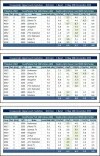
I have attached the feed/scalar pair tables for 38.0 East below. The setup was a Titanium WiMax LNBF in a fake ADL linear polarity feed pipe on a Precision 2.0m dish. The feed pipe was laser focused for each table.

The number before the / character is the distance in millimetres of the feed throat aperture from the centre of the dish. The number after the / character is the distance in millimetres of the scalar along the feed barrel from the feed throat aperture. The /NS values indicate no scalar present.

.
38.0E_20191220_FSP.webp
 
I have attached the feed/scalar pair tables for 38.0 East below. The setup was a Titanium WiMax LNBF in a fake ADL linear polarity feed pipe on a Precision 2.0m dish. The feed pipe was laser focused for each table.

The number before the / character is the distance in millimetres of the feed throat aperture from the centre of the dish. The number after the / character is the distance in millimetres of the scalar along the feed barrel from the feed throat aperture. The /NS values indicate no scalar present.

.
View attachment 127485

Pretty good results overall with the replica ..... M.B.

The offset L.N.B. arrangement i,v been using on the 2.4 is o.k. for general C band viewing but no good for the weak signals on this sat offset arrangement.webp
the only transponder i can lock here at the moment is the Radio Pakistan one - 3847 H 1080
The weather is much improved here today - so may remove the sub assembly and fit one C band l.n.b. in a central position and see what will lock for me up here in the North West .....
 
Pretty good results overall with the replica ..... M.B.

The offset L.N.B. arrangement i,v been using on the 2.4 is o.k. for general C band viewing but no good for the weak signals on this sat View attachment 127487
the only transponder i can lock here at the moment is the Radio Pakistan one - 3847 H 1080
The weather is much improved here today - so may remove the sub assembly and fit one C band l.n.b. in a central position and see what will lock for me up here in the North West .....


Thanks Nelson.

I did a bit of fine tuning of the Az/El and polarity skew to squeeze the last drop of juice from the signals. It was after the fine adjustment that I got a lock on 4081 V (ATV Pakistan) which I had never managed before.

I noticed that the feed/scalar pair distances for the 9 different frequencies that I locked had only a small pattern. It looked like the scalar distance of 5mm to 15mm was the optimum but not a hard and fast rule. I think that with some of these extreme fringe satellites like 38.0 East each frequency might have its own optimum parameters? The solution is a larger dish or a more favourable location for the beam footprint.

If you centrally locate the C-Band feed arrangement on your 2.4m dish it will be interesting to see what results you get, particularly any variance in signal levels from feed/scalar pair adjustments. I found that Samaa TV and Madani are easiest frequencies to lock, they always seem to be present any time of day and can both tolerate a lock of tweaking before losing a lock.
 
Back
Top