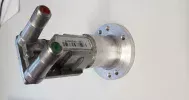
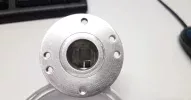
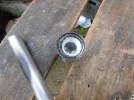
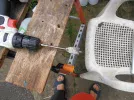
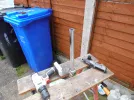
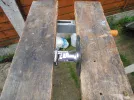
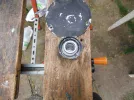
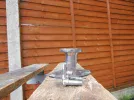
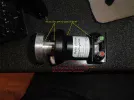
Whilst waiting for the calipers to arrive I decided to tackle the waveguide depth which was previously 9.8cm
We need to be in the 7 to 8cm range..
So out came the hacksaw again...and an hour later the offset feed is reduced again to the point at which the flaring reaches 3cm diameter..
This still leaves enough flange to be used to bolt the 2 items together..
It also allow me to properly measure throat diameter once those calipers arrive.
And the real purpose of this process ..reduces waveguide depth to 7.8cm (the sweet spot).
and finally ...it removes even more cast aluminium bulk...thus the sleeve piece can be even shorter.
At this point the short 'sleeve' could be made by inserting a small section of pipe into the sloping mouth of the bullseye and pouring silver epoxy into the space around the centre pipe ...and that is the route I would take if silver epoxy wasn't so ridiculously expensive.
perhaps there is a cheaper alternative I'm unaware of ?
Must be pourable/moldable and conductive when cured ?
cest la vie
rgds
Just discovered that
Aluminum Metal Repair Epoxy Adhesive Glue 1 Set Strong Bond Machinable Sandable
can be got from China at £3 approx.....but no idea if this is truely ally ...and conductive.
Anyone used it ...???
Just asked google AI :-
Properties of Standard Metal Repair Epoxy
- Strong Bond: Creates a rigid, high-strength structural hold on aluminum, iron, and steel without needing high heat or welding tools. [1]
- Electrical Insulation:
Standard epoxy resins act as electrical insulators. They block electricity rather than conduct it
- If your repair specifically requires electrical conductivity (such as fixing circuit traces or electronic grounding tabs), standard metal repair epoxy will not work. Instead, you must use a specialized electrically conductive adhesive infused with metal particles, such as MG Chemicals 8331D Silver Conductive Epoxy Adhesive