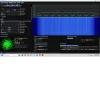
As to the acid trip if you don't want the waterfall display then under the "FFT" settings you can turn it off.
And under the "processing" settings there is an option to off set the frequency called "frequency shift" this may or may not fix the DC spike problem.
Here is a look at my display, as you can see I have some spikes but they do not affect the decoding.
View attachment 168458
I hope it's okay to discuss this in this thread.
I can receive 137 MHz sats. unitl the cows come home. The YouTube guy saveitforparts is inspiring me to start building a rbust tracker from a heavy duty surveillance camera mount. Something that will handle a larger dish than what I'm currently using.
SatDump is going to now need a lot of reading. Hoping I can find something that targets GOES satellites specifically.
I have a lot of questions. Terry. I'm guessing you haven't worked GOES at all.
I'm looking at the easiest way to get any sort of data at all GOES West is out of my view. So East is the target.|
I dont care. Text. Bulletins, telemetry data. Anything to at least show I might have adequate signal strength to receive it.
I'll slap up a photo or two before I sign out here. Over the days since I last was here. I've used my nanovna to build and tweak a new patch panel for my MSA that I used for Inmarsat. Inmarsat just "screams in". A dish isn't even needed for some signals from it.
That's the kicker. It was initially built for RHCP. For using it on the Raven/Viasat/Tooway dish I modded it for LHCP.
Inmarsat was impressive.
Next I looked for online patch antenna calculators and punchd in the numbers to mod the Inmarsat patch for GOES at 1694 MHz and making it linear. Not knowing if the holes I drilled in the initial paolarzed patch were screwing up performance. I used nylon flat head screws for a perch for the new pacth and spaced it at the design at 7mm from the backplane. The backplane dimensions were on par for the GOES active element. So I used it. The screws let me vary spacing to tweak in the VNA readings.
Soldered in a "cats whisker" on the SMA connector soledere to the backplane. That let me float the copper patch until SWR/Return Loss/Impedance were matched for 1694 MHz. A bit of trimming, actually filing, of the patch to bring it into resonance. Mark and drill the panel for the SMA center pin. As spot-on as could be. I cut the patch a touch bigger to start.
Because the dish look angle is built in. I set the degree scale for what Dish Pointer said to. Then positioned the patch for the exact highest signal strength as humanly possible.
Moving back to the LHCP helical. I may be repeating myself. Sorry if so. 7 turns and used on the dish resulted in too narrow beamwidth (but better gain) for the dish. So I trimmed first 1/2 turn from it. Using the dish specs converted from it's ka band design to l band,
Ended up now at 6 turns.
The design came from RF World. Showing the triangular impedance match. My VNA showed something like a low of 80 ohms impedance at a much lower target frequency. I soldered a piece of brass strip from another design to the triangle and bent it for a low 1.0 SWR and as close to 50 ohms impedance at 1694 MHz.
Put it on the dish after adding a reflector (cake tin lid) stiffener and trimming the lid to be flat.
Man. I'm trying here.
It's tweaked for the highest signal as can be had.
Belden 9913 coax. N-Type to SMA adapters. Nooelec LANA LNA. SDRPlay RSP2.
Usiing a DC block at the LANA. So no RSP1 biat t. LANA powered standalone from 5VDC. Didn't really notice a DC spike change.
SatDump Decimation at 1. Samplerate at 10 Msps.
Thought because signal was weak I needed my LNA set to max. at 8.
You just can't zoom into your received signal to see it in detail and if you're centered like you can with SDR software.
Played with LNA levels. Played with IF gain. You name it.
GOES-R HRIT. I get Viterbi Synced. Never ever get Deframer to do squat.
The BPSK "kaleidoscope". I've tried setting signal levels all over the place to get something like the (what's it called??) "Constellation". Yeah. that's it. Constellation that other programs ( Jaero, FSK, PSK, etc.) decoders show. Two dots, four dots. You're golden.
Anyone working GOES here? What is the easiest decoder to try to at least know I can get it to work. Then I can go from there.
In SatDump. When synched and seeing Viterbi supposed packets streaming in the window.
In the Signal window. A always see SNR (d

at 0.
Playing around with lowering LNA Gain and IF Gain. To a much lower setting that expected. All the while retaining Synced in the Viterbi window.
I finally can get what looks like packets streaming in the Signal window and the Avg SNR (d
levels pop above 0.
Played with IF gain. Tried all different AGC modes.
In the screenshot I have to tune to what is shown to get any ativity in the Signal window with maybe an Avg SNR (d
of 0.3ish. And the Peak SNR (d
only comes from moving the slider that cause a jump (glitch) in their movement.
Help? I'm really trying here.
Edit:
The heck? Decibels. Not deci-the_Fonz-smilies!!!



 .
.